Short answer: small business automation starts not with AI and not with a «big system», but with the most painful process — usually lead intake or client booking. The right order: (1) online booking or request forms, (2) automatic reminders, (3) a single client base in a CRM, (4) online payments, (5) reports, and only then (6) complex integrations and AI. The starting budget is minimal: ready-made subscription services cost from a few hundred hryvnias per month, the first integrations from UAH 5,000–15,000. A realistic rollout plan is 90 days, one process at a time.
This article is the front door to our whole series: if you still keep records in a notebook and take requests scattered across Viber, DMs, and phone calls — it's for you. No pathos about «digital transformation»: just the order of actions, prices, and typical mistakes.
4 signs it's time to automate
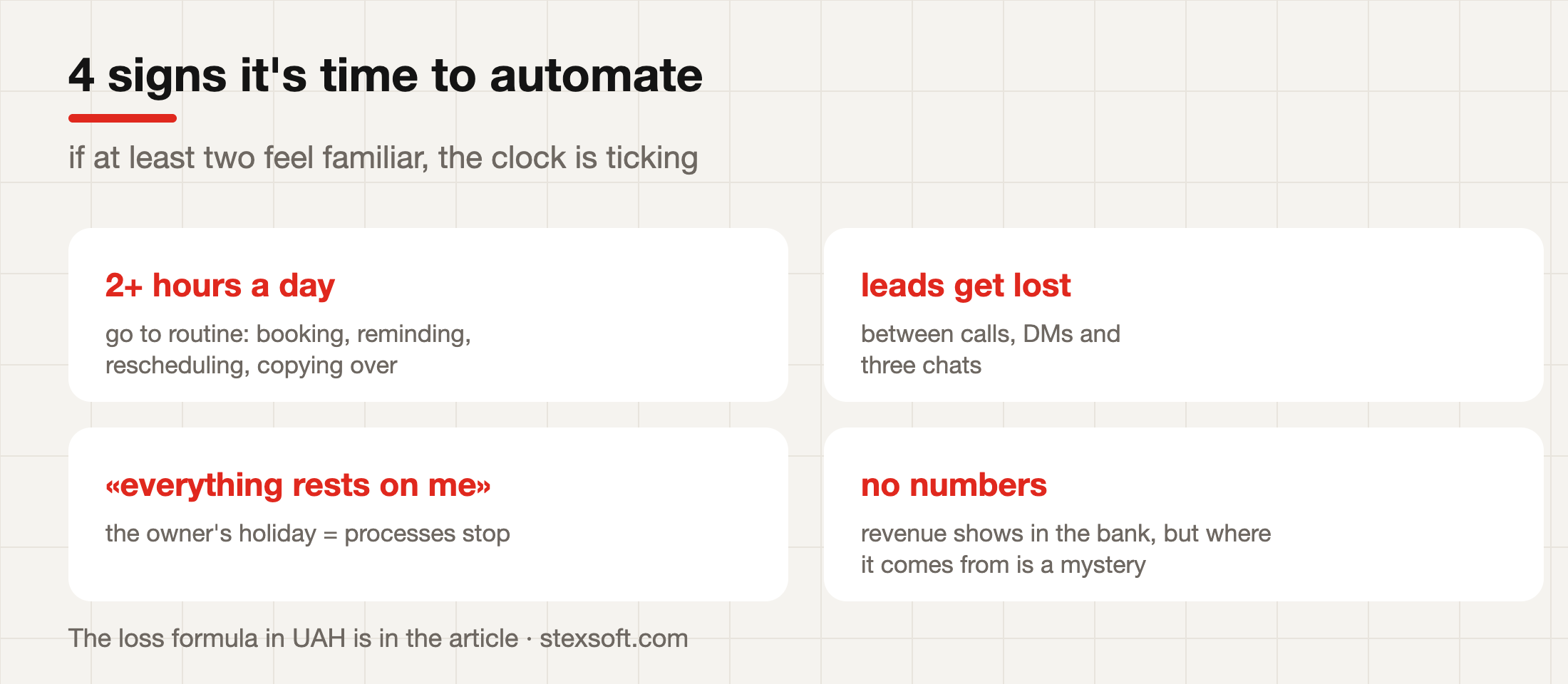
- 2+ hours a day go to routine: booking a client, reminding, rescheduling, copying from a messenger into a notebook, from the notebook into a spreadsheet. Count honestly over a week — the figure is usually shocking.
- Leads get lost. A missed call while you're with a client, an unnoticed DM, «I'll call back» — and nobody did. Every lost lead is your advertising budget gifted to a competitor.
- Everything rests on the owner. A holiday or illness = processes stop, because the schedule, prices, and agreements live in your head.
- No numbers. Revenue is visible in the bank, but how many clients came, how many returned, where they came from — «it seems» instead of «I know».
The loss-estimation formula is simple: (routine hours per month × hourly cost) + (lost leads × average ticket × conversion). For a typical salon, workshop, or small service business the total comes to UAH 10,000–30,000 per month — and that's exactly what working from a notebook «eats».
The right order: why AI is step six, not step one
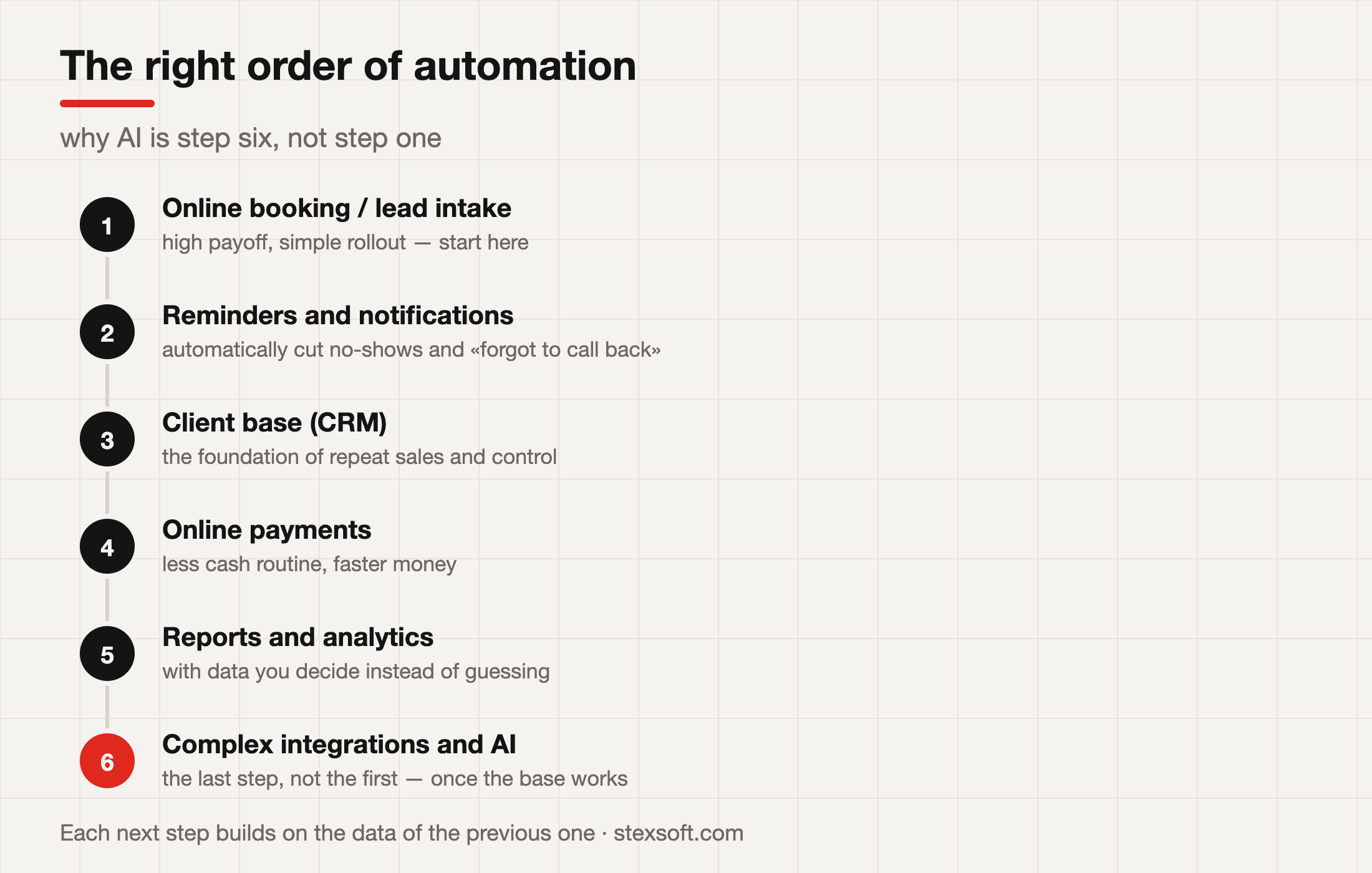
The most expensive mistake is to start with what's fashionable: «I want an AI bot». Automation works like construction: every floor rests on the one below.
Step 1. Online booking or lead intake. Maximum return for minimal money: the client books themselves, at any time, without a call. For service businesses that means online booking (a website, a Telegram bot, or a ready-made service); for others — proper request forms with an instant notification to your messenger.
Step 2. Automatic reminders. An SMS or Telegram message the day before the visit. The fastest payback on the whole list: reminders cut no-shows roughly in half, and no-shows are direct losses.
Step 3. A client base (CRM). A single place where all clients, visits, requests, and agreements live. It's the foundation of repeat sales — and in services, repeat visits generate most of the revenue. For salons and booking-based services there are ready-made industry solutions by subscription; what such a system can do and what it costs — we covered in detail in our article on CRMs for salons.
Step 4. Online payments. Prepayment for a booking disciplines clients, and payment by link saves time. How to choose acquiring with the lowest fees — in our comparison of monobank, LiqPay and WayForPay.
Step 5. Reports and analytics. Once the first four steps are running, the data accumulates by itself — and for the first time you get honest answers: which service earns, which ad channel pays off, how many clients come back.
Step 6. Integrations and AI. And only now — AI agents, complex links between the website and the CRM, document automation. At this stage they land on a working system and real data — not on chaos, which they would simply make faster.
The 90-day plan
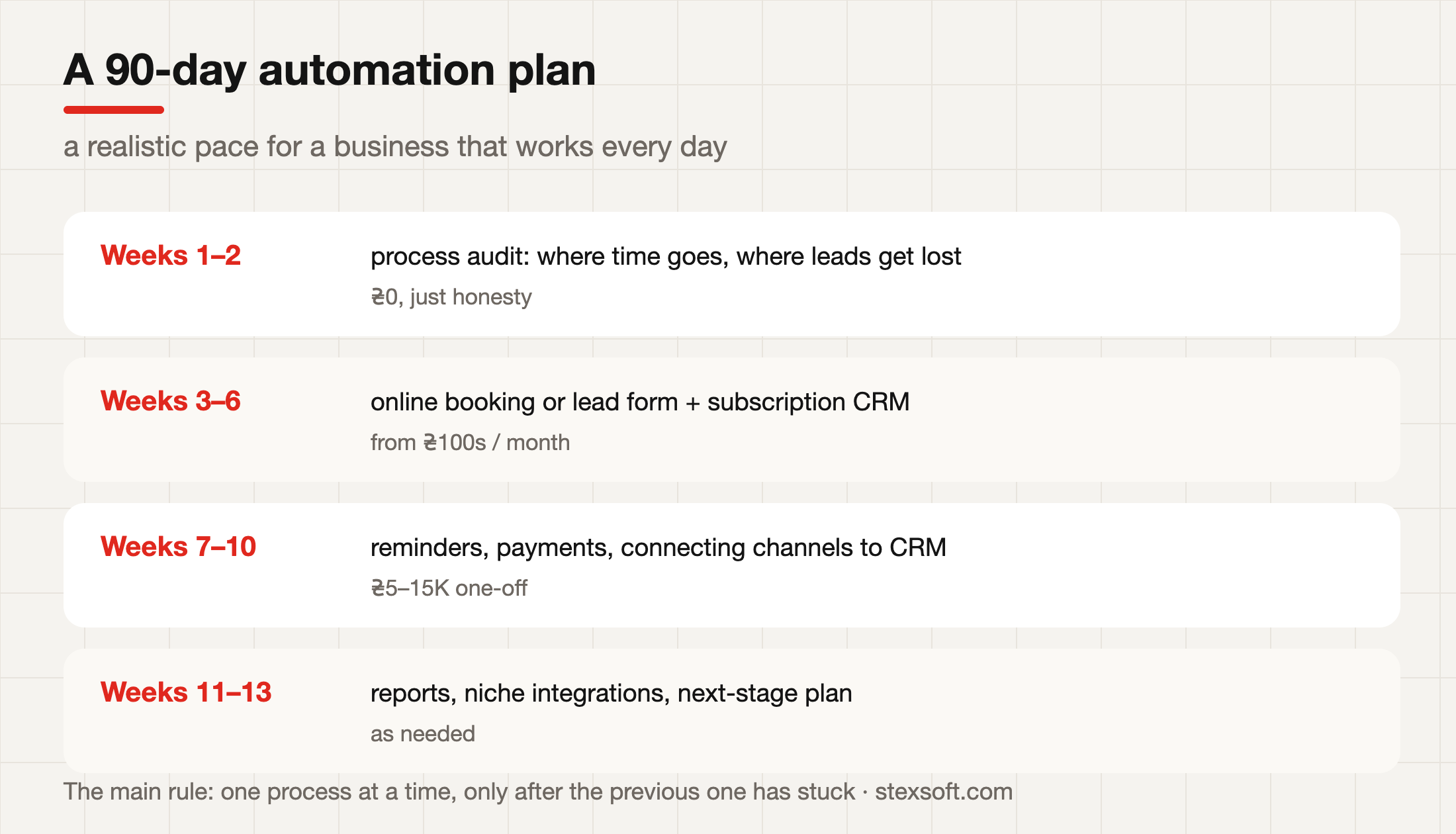
A realistic pace for a business that keeps working every day:
| Period | What we do | Budget |
|---|---|---|
| Weeks 1–2 | Process audit: where the time goes, where leads get lost, which 3 processes hurt most | UAH 0, just honesty |
| Weeks 3–6 | Online booking / request forms + a subscription CRM; migrating the client base | from a few hundred UAH/month |
| Weeks 7–10 | Reminders, online payments, connecting channels (website, Instagram, Telegram) to the CRM | from UAH 5,000–15,000 one-off |
| Weeks 11–13 | Reports, small refinements based on results, a plan for the next stage | as needed |
The main rule: one process at a time. The team needs to get used to a new tool before the next one appears. Trying to roll out everything at once is the second most common reason automation fails.
The first is rolling out and not using it: a CRM that managers don't enter clients into is worse than a notebook, because it creates the illusion of a system. So from the start, make one person responsible for keeping «everything living in the system», and check it personally for the first months.
Typical mistakes (and how to avoid them)
- Starting with a tool instead of a process. First describe how a request or booking should flow — then look for a tool to match, not the other way round.
- Choosing the «most powerful» system. A hundred-feature combine for a team of three is money paid for complexity nobody will use. For most small businesses simple industry-specific solutions win.
- Automating chaos. If a process doesn't work manually, automation won't fix it — it will speed it up. Order first, speed second.
- Not measuring the effect. Record the «before» numbers (routine hours, no-shows, lost leads) — otherwise in six months there'll be no answer to whether it was worth it.
- Forgetting the people. Half an hour of team training and a simple «here's why we need this» save months of quiet sabotage.
Frequently asked questions (FAQ)
StexSoft builds automation for small businesses step by step: online booking, Telegram bots, CRM, payments, website integrations. Describe what your typical day looks like — we'll tell you which step will bring the biggest effect first.
How much does small business automation cost?
The start — from a few hundred hryvnias a month for ready-made services (booking, CRM). First integrations — UAH 5,000–15,000 one-off. Comprehensive links with a website and telephony — from UAH 15,000–40,000. That's an order of magnitude less than the typical monthly losses from manual routine.
Where to start if there's almost no budget?
With the free part: a process audit + online booking or a request form on a ready-made service + auto-reminders. These two steps alone remove the biggest losses.
A ready-made service or custom development?
For 90% of small businesses — ready-made subscription solutions: fast, cheap, no development risks. Custom development is justified for non-standard processes or chains with several branches.
How long does the rollout take?
The basic loop (booking + reminders + CRM + payments) — realistically 90 days at a calm pace, one process at a time.
Do I need a website for this?
Not necessarily at the start: booking can live in a Telegram bot or on a service page. But a website becomes the next logical step — it's a lead channel that belongs to you, not to social media algorithms.
What should NOT be automated?
Live communication where it is the product: consultations, conflict resolution, high-ticket sales. Automation should free up time for that, not replace it.

Comments(0)
No comments yet — be the first.
Comments are moderated before they appear.
No comments yet — be the first.