More and more people look for contractors, products, and services not on Google but in a chat with an AI. The user asks: «Recommend a CRM for a beauty salon in Ukraine» or «Who builds WooCommerce websites in Vinnytsia» — and gets a ready answer with three to five names. If your brand isn't there, you lose the deal before the client has even seen your website.
Optimising for AI answers is called GEO (Generative Engine Optimization) or AEO (Answer Engine Optimization). In this article we break down the principle by which AI systems choose their sources, why they cite your competitors instead of you, and what exactly to change on your website to fix it.
Why classic SEO is no longer enough
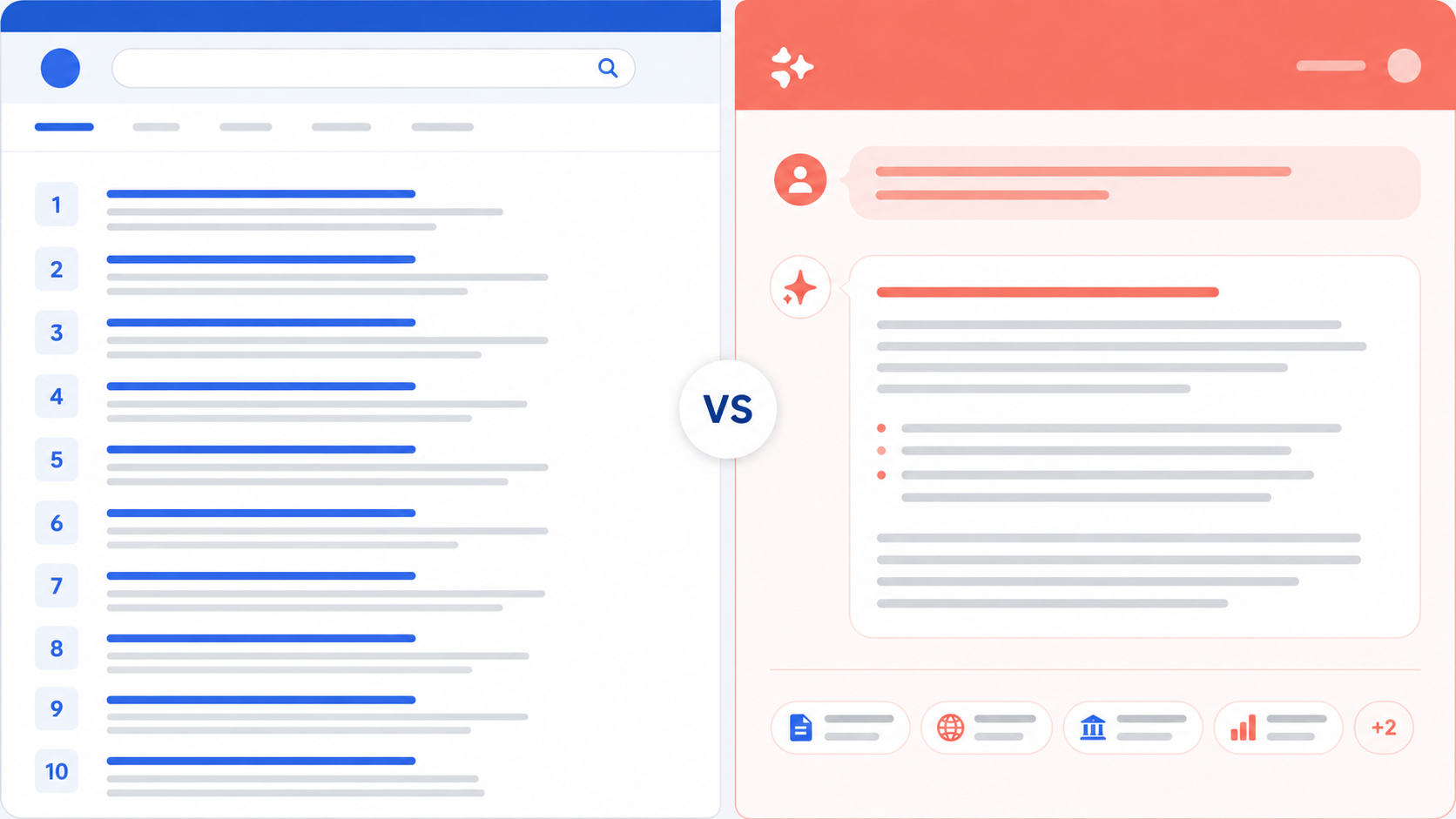
A search engine shows ten links — and the user chooses where to click. An AI works differently: it assembles an answer from several sources and delivers it as a single text. The user may never visit the websites at all — they got their answer in the chat.
This changes the rules of the game in two ways:
First. The competition is not for a top-10 position but for the role of the source of a fact. AIs don't cite «the best website in general» — they cite the page from which it's easiest to extract specific, verifiable information for a specific question.
Second. What's evaluated is not a single page but the entire entity of the brand: how consistent the facts about the company are across the website, social media, directories, and external publications; whether it's clear who you are, what you do, and what backs it up.
The good news: most GEO work is not magic but systematic content and technical hygiene. And much of classic SEO works here too: if the site indexes well and has authority, that's already half the job.
How information gets into an AI answer (or doesn't)
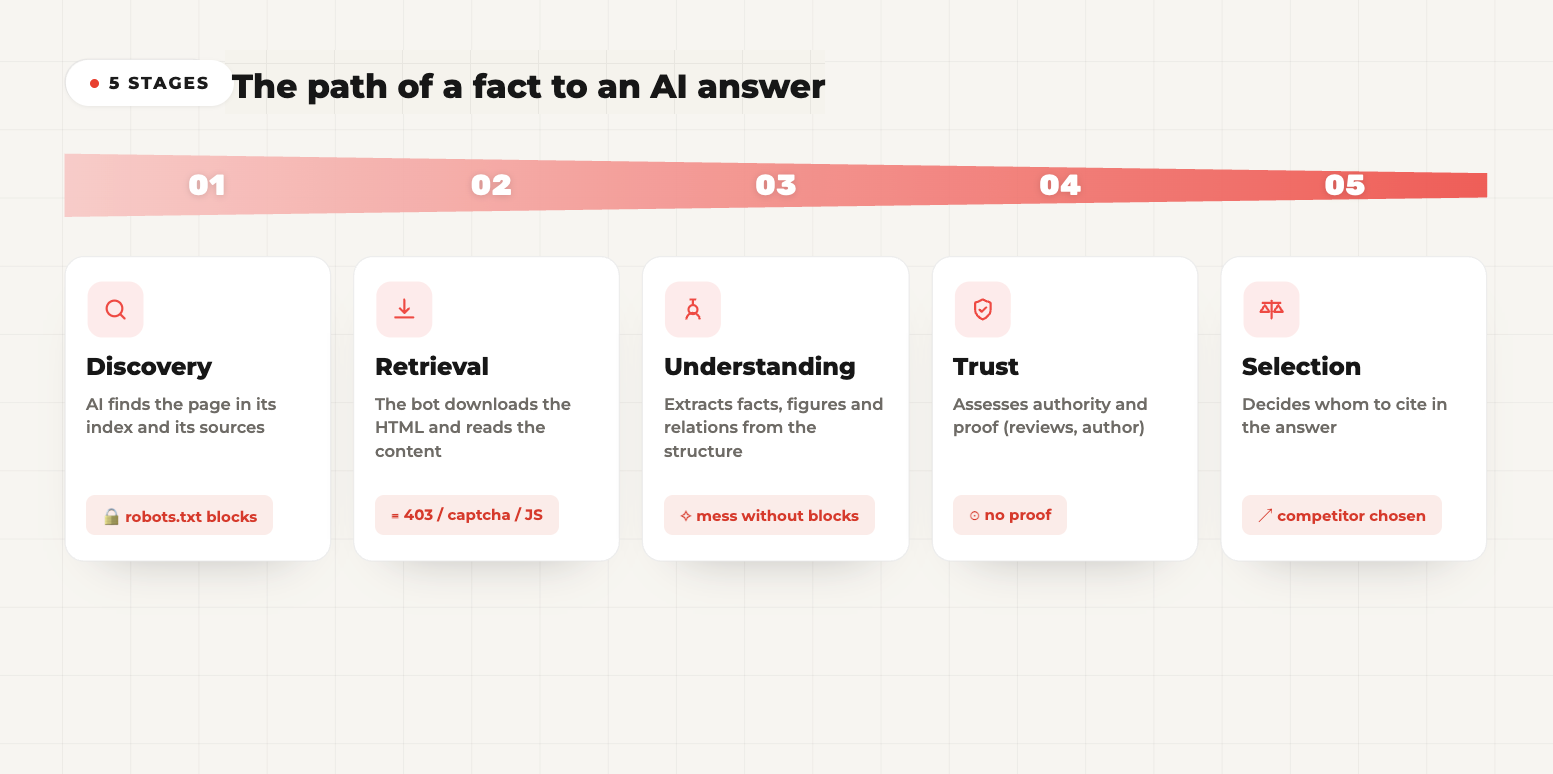
To understand where exactly you lose visibility, it helps to picture the path information travels from your website to the answer in a chat. Something can go wrong at every stage:
- Discovery. The AI's bot has to find the page. If it's blocked in robots.txt, missing from the sitemap, or only accessible after login — the path ends there.
- Retrieval. The bot has to get the text. Bot protection (Cloudflare, WAF), captchas, content that loads only via JavaScript after user actions — all of this can serve the bot an empty or truncated page.
- Understanding. The system has to grasp what the page is about and what a fact belongs to. If the price lives in a PDF price list, the case studies in another section with no interlinking, and the terms in a presentation, the answer falls apart into disconnected fragments for the AI.
- Trust. The system has to see why a claim can be believed: specific figures, case studies, an author with expertise, external confirmations.
- Selection. Even if everything is fine, the AI may pick another source — one that's more complete, fresher, or better substantiated.
The practical takeaway: diagnostics starts with the question «at which stage does the information get lost». If the bot can't see the page — that's a developer's task, not a copywriter's. If the page is visible but the fact is worded vaguely — that's an editorial task. If there are enough facts but a competitor gets cited more often — it's a question of external confirmations and PR.
Step 1. Define which queries you want to appear for
A GEO audit starts not with the website but with the user. Compile a set of real questions your potential clients ask AIs. Roughly, they fall into several types:
- Brand — «what is StexSoft», «StexSoft reviews». These check whether the AI knows the company exists at all and describes its business correctly.
- Category — «web studios in Ukraine», «who develops WooCommerce online stores». This is where it's decided whether you make the shortlist when the client doesn't know you yet.
- Product — «what's included in turnkey online store development», «how long does Laravel website development take».
- Comparison — «OpenCart or WooCommerce for a store», «freelancer or studio for website development».
- Commercial — «how much does a website for a beauty salon cost», «monthly WordPress support cost».
- Problem — «my website got hacked, what do I do», «my store loads slowly, how to speed it up». The user isn't looking for a contractor yet — they're looking for a solution. But this is exactly where trust is built with whoever explained that solution.
Then you run every query through several systems (ChatGPT, Gemini, Perplexity, Copilot) and record: were you mentioned, who was mentioned instead of you, which sources are cited. A single run proves nothing — AIs can assemble the answer differently every time, so do several repeats and look at the stable picture.
Step 2. Break every query down into the facts the user needs
Behind every question stands a set of facts without which the answer is incomplete. A person asking «how much does an online store cost» actually wants to understand: the budget range, what the price depends on, what's included, what the extra costs will be (hosting, support, licences), and how long it will take.
Build a table: query → the user's task → the list of facts → where those facts should live on the site. That is your content plan.
There's an uncomfortable point here worth stating honestly. Businesses often find it convenient to write «the price is calculated individually, leave a request». But the user needs at least a reference point: a range, the pricing principle, the factors that affect it. If your website lacks these specifics and your competitor's has them — the AI will cite the competitor. It looks for whoever answered the question, not whoever asked for contact details.
Step 3. Make every important page a self-sufficient answer
AIs extract fragments from pages — standalone semantic blocks. So every important fact should be worded so that it's understandable on its own, without the context of the whole page.
Compare two versions:
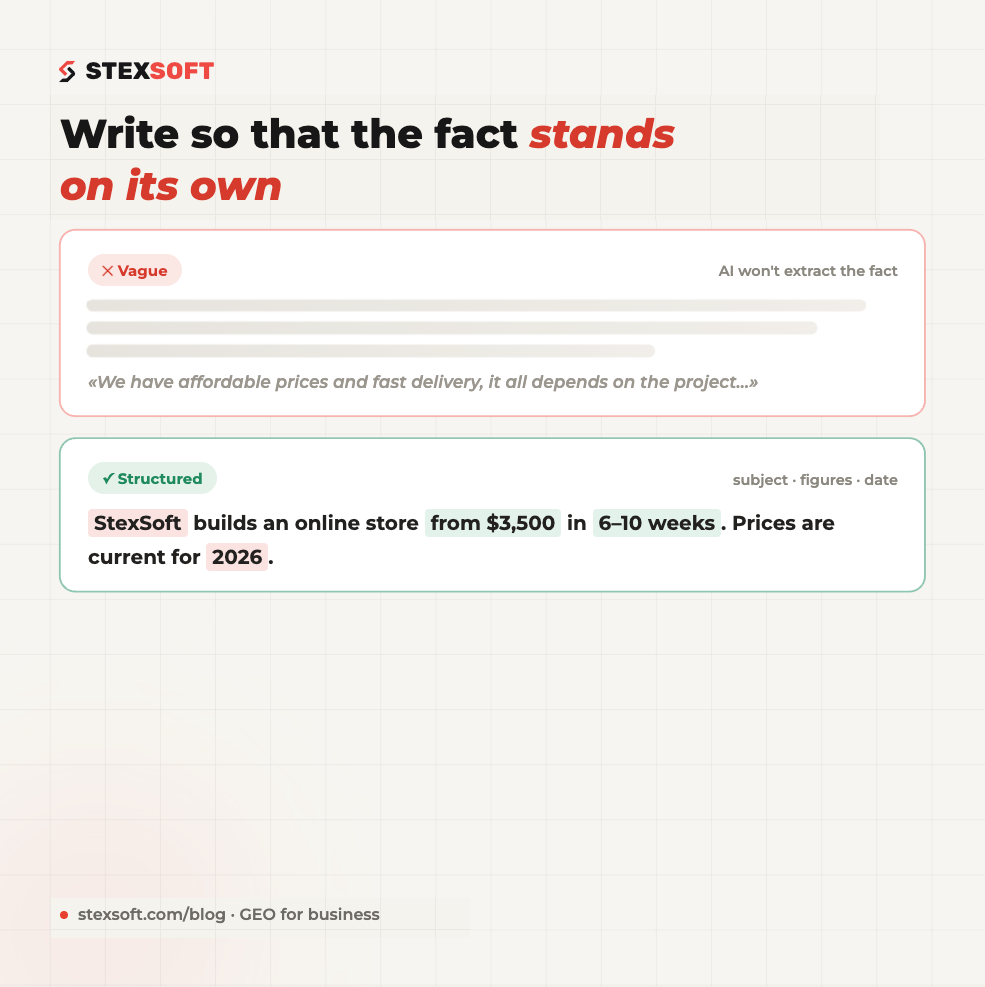
❌ «We work fast and always meet deadlines. The cost depends on the project.»
✅ «WooCommerce online store development at StexSoft takes 4–8 weeks and costs from $2,500. The price includes design, front-end, payment setup (LiqPay, monobank) and delivery (Nova Poshta), import of up to 500 products, and admin training. Prices are current as of July 2026.»
The second block an AI can take and quote in full: it has a subject (who), a service (what), figures (how much and for how much), scope, and a validity date. The first block gives the system nothing.
Practical rules for semantic blocks:
- One block — one user question. Word the H2/H3 heading close to the real question.
- The first sentence of the block should contain the direct answer. Details and nuances come after.
- Write figures, timelines, and terms explicitly, not «it depends on many factors».
- State a validity date for prices and terms — it's a freshness signal.
- Avoid empty wording: «individual approach», «team of professionals», «results-driven» — for an AI this is noise with no factual payload.
Step 4. Remove the technical barriers
Even a perfect text is useless if the bot can't see it. The minimal technical checklist:
robots.txt and AI crawlers. Check that AI bots aren't blocked: GPTBot and OAI-SearchBot (OpenAI), ClaudeBot (Anthropic), PerplexityBot, Google-Extended. An important nuance: some platforms have separate bots for model training and separate ones for search with source citations. By blocking everything «so they don't steal content», you can cut yourself off from cited answers.
Rendering. If the main content is loaded by JavaScript, verify it's present in the final HTML the bot receives. For SPAs this is critical: a catalogue page that's an empty div without JS simply doesn't exist for some crawlers. The solutions are SSR, prerendering, or static generation of key pages.
Bot protection. Cloudflare and other WAFs can serve AI crawlers a captcha or an error while the site works fine for humans. Check your server logs: what status codes AI bots receive. Cloudflare has dedicated settings for verified AI bots — use them instead of blanket blocking.
Content behind a click. Tabs, accordions, «show more», calculators — if a critical fact appears only after a user action, there's a risk the bot won't get it. Key information should be in the HTML right away.
PDFs, images, video. A price list in PDF, specs on an image, terms in a video — all weak carriers of facts for an AI. Duplicate the critical parts as text: an HTML table instead of a price list screenshot, a text transcript or key points for a video, an annotation with the key figures next to a PDF document.
Step 5. Build a support system around the page
AIs evaluate not only the page itself but how well it's embedded in a reliable system of sources.
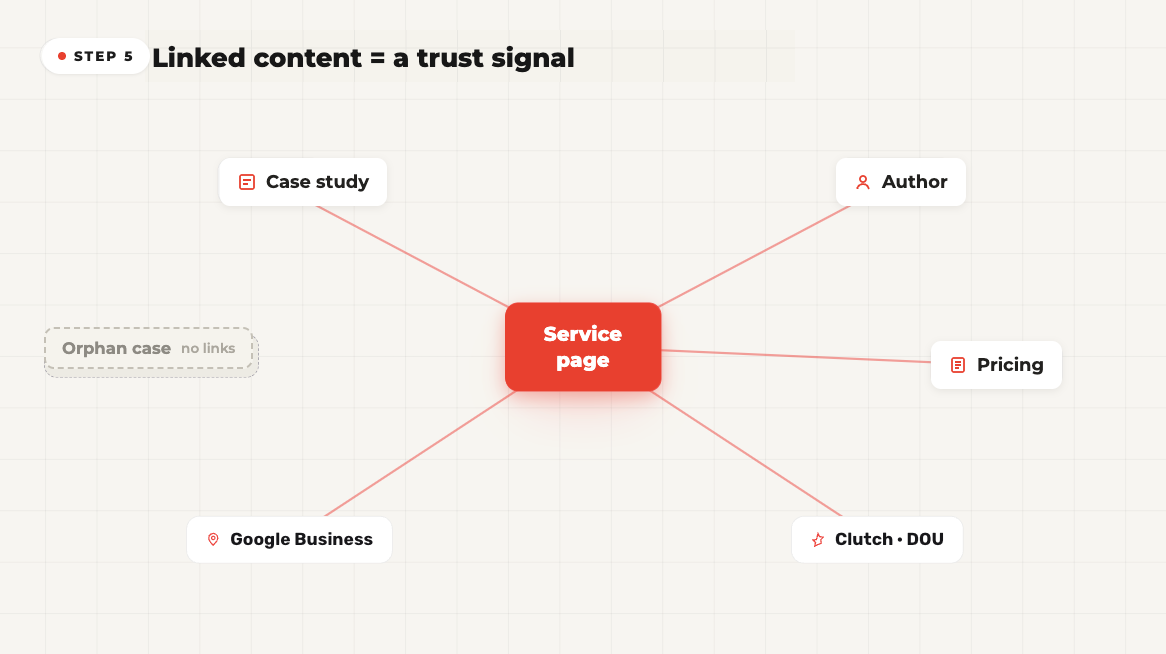
Internal connectivity. A service page should link to case studies of that exact service, to team profiles, to pricing and terms. Not just «see our portfolio», but contextual links: «how we made an OpenCart store 3× faster — the TerraHome case». A case study lying in a void with no link to the service is an «orphan»: it may be excellent, but the system won't understand what it proves.
Consistency of facts. If the service page says «from 4 weeks», the PDF presentation says «2–3 weeks», and the Clutch profile says «1 month» — the system struggles to pick the right version and may cite the outdated one. Keep an internal reference document: one approved version of every critical fact (prices, timelines, service scope, geography, contacts) and regularly check every carrier against it — website, presentations, directories, social media, external profiles.
External confirmations. Profiles on DOU, Clutch, GoodFirms, Google Business Profile, mentions in industry media, client reviews on external platforms — all of this confirms the company's entity beyond your own website. AIs lean heavily on aggregators and ratings when they build lists of «best contractors».
Evidence for claims. The rule is simple: the stronger the claim, the closer the proof should be. If you wrote «we made the site 3× faster» — right next to it there should be a link to the case study with the starting metrics, the actions, and the result. A claim without proof one click away is a weak signal.
Step 6. Add structured markup — but without illusions
Schema.org (most conveniently as JSON-LD) helps machines understand the entities on a page: Organization, Service, Product, Article, Person, FAQPage, BreadcrumbList, Review.
It's especially useful to link entities to each other via identifiers (@id): the article is written by an author → the author works at the company → the company provides the service → the service has reviews. Such a graph helps the system match facts to the right objects precisely.
But keep expectations realistic: markup does not create content. There is no «magic AI markup» that guarantees a place in the answers. If a page has no facts, Schema.org won't invent them. Markup amplifies what's already there — nothing more.
Step 7. Measure not mentions, but correctness of citation
The metric «the brand was mentioned» is weak. It's far more important to check four things for every key fact:
- Did the fact appear in the answer?
- Is there a link to a source next to it?
- Is that source your page, where the fact is actually written?
- Is the value passed on without distortion (the same price, the same timeline, the same terms)?
If the AI links to your website but quotes an old price — somewhere in the loop lives a strong outdated signal: an old page, a cached presentation, a third-party directory. That's a find-and-clean-up task.
And remember the instability: AI answers vary from request to request. Do several runs of every control prompt, log the results in a table, and compare the dynamics once every month or two, not by single answers.
Common myths about GEO
«There's a special writing style that AIs love.» No. What helps is clarity, specific facts, self-sufficient blocks, and clear headings — the same things that help humans. A universal «formula for AI» doesn't exist.
«You need to add an FAQ to every page.» An FAQ is useful where there are real short questions not covered by the main text. But splitting a complex topic into a dozen Q&As means losing the context and making things worse. The format is chosen to fit the need, not the other way round.
«Adding llms.txt is enough.» It's an experimental format with no confirmed effect on citation. Worth testing on sites with large documentation, but there are no grounds to consider it a mandatory minimum.
«GEO is something separate from SEO.» Mostly no. Technical accessibility, indexing, domain authority, quality content — the foundation is shared. GEO adds on top the work with facts, their connectivity, their evidence, and monitoring of AI answers.
Action plan for the first month
Compressing all of the above into concrete steps:
- Compile 15–20 control queries across intent types and run them through ChatGPT, Gemini, and Perplexity. Record who gets cited.
- For the 5 most important queries, build a fact map: what exactly the user needs to know and where it should live on the site.
- Run a technical audit: AI bot access in robots.txt, response statuses in the logs, content visibility in HTML without JavaScript.
- Rewrite 3–5 key pages on the principle of self-sufficient semantic blocks: specifics, figures, dates, service scope.
- Link service pages to case studies with contextual links. Give the case studies starting data, actions, and a measurable result.
- Check the critical facts (prices, timelines, contacts) across all carriers and remove contradictions.
- Add JSON-LD markup for Organization, Service, and Article with links between the entities.
- After 4–6 weeks, repeat the measurement with the same prompts and compare.
GEO is not a one-off trick but a cycle: measure → find the gap → fix it → verify → move to the next scenario. But it's exactly this systematic work that yields a lasting result — one that won't vanish after the next model update.
Want to know how your business looks in AI answers? The StexSoft team will run a GEO audit: we'll check your website's technical accessibility for AI crawlers, analyse who gets cited instead of you, and draw up a concrete work plan. Leave a request →


Comments(0)
No comments yet — be the first.
Comments are moderated before they appear.
No comments yet — be the first.