Short answer: for a store of up to 500 products with standard processes, choose WooCommerce (WordPress) or OpenCart — starting from UAH 25,000–40,000 with a launch in 3–8 weeks. Laravel is needed when there's non-standard logic: B2B price lists, customer accounts with complex permissions, real-time warehouse synchronisation — that's from UAH 150,000, but with no limits on growth. There is no «best platform in general» — there's the best one for your task and budget.
We at StexSoft build stores on all three platforms, so we have no reason to «sell» any particular one. Below is an honest comparison across 6 criteria, three typical cases from practice, and a cheat sheet for choosing.
Comparison across 6 criteria
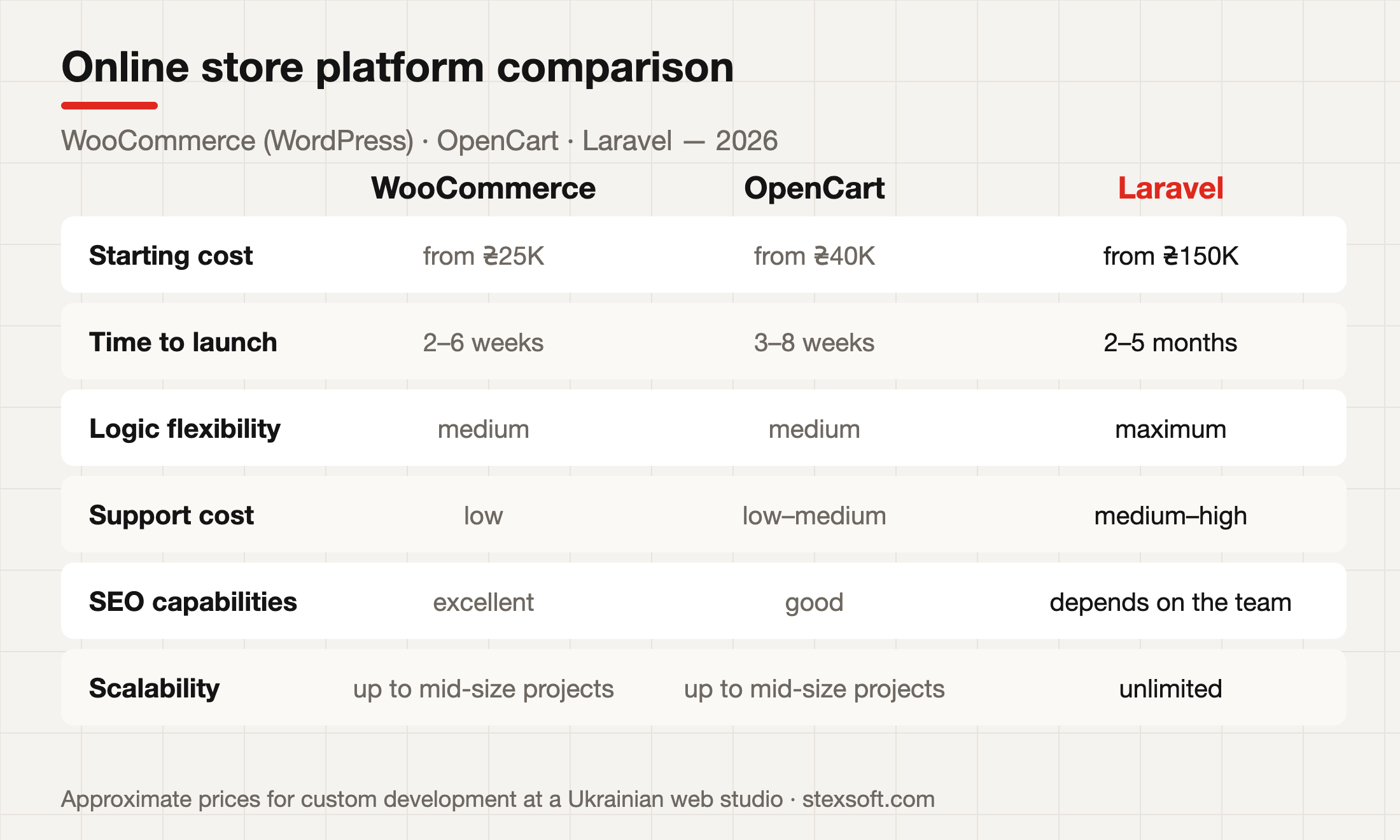
| Criterion | WooCommerce | OpenCart | Laravel |
|---|---|---|---|
| Starting cost | from UAH 25,000 | from UAH 40,000 | from UAH 150,000 |
| Time to launch | 2–6 weeks | 3–8 weeks | 2–5 months |
| Logic flexibility | medium (plugins) | medium (modules) | maximum |
| Support cost | low | low–medium | medium–high |
| SEO capabilities | excellent | good | depends on the team |
| Scalability | up to mid-size projects | up to mid-size projects | unlimited |
More on each point below. But first, the main idea of this article: the cost of a platform is not only the development price but the cost of ownership over 3–5 years — support, refinements, speed, and how easy it is to switch contractors.
WooCommerce: when the store is an extension of a content site
WooCommerce is the e-commerce plugin for WordPress that powers the largest share of stores in the world. Its strengths:
- The cheapest professional start. A huge market of themes and plugins: payments, delivery, filters — everything is already written.
- The best out-of-the-box SEO foundation. WordPress was born as a content platform, so a blog, articles, and landing pages are natural here. If your strategy is to attract traffic with content (and in 2026 that also means GEO optimisation for AI search), WooCommerce wins.
- Easy to find a contractor. WordPress developers are the most numerous in Ukraine — you're not «married» to one studio.
Weak spots: with a catalogue of 3,000+ products and dozens of plugins the store needs serious speed optimisation (caching, LiteSpeed, cleaning out excess plugins), otherwise Core Web Vitals suffer — and that means both rankings and conversion. We covered this in a separate article on website speed.
A typical case from practice. A home goods store, ~400 items, the owner ran a blog with product roundups. WooCommerce + speed optimisation + LiqPay and Nova Poshta integration. The budget stayed within UAH 90,000, launch in 6 weeks. A year later the blog brings over a third of the organic traffic — exactly what WordPress was chosen for.
OpenCart: when you need precisely a store, and nothing else
OpenCart is a CMS built specifically for e-commerce. Catalogue, attributes, product options, multi-currency and multi-language — these are the system's core, not a plugin.
- Well-designed handling of a large catalogue. Attributes, series, options, filters — native mechanics.
- Lighter than WooCommerce at the same volumes. Less of the content-platform «legacy».
- Popular in Ukraine. Plenty of local modules for our realities: Nova Poshta, Ukrainian payment gateways, marketplace feeds.
Weak spots: content marketing (blog, articles) is weaker than in WordPress; the quality of third-party modules is uneven — here the contractor's experience is critical: knowing which modules are safe to install and which will «take the store down».
A typical case from practice. An auto parts store, 8,000+ items with constantly updated supplier price lists. OpenCart + a price import module + filters by make/model. WooCommerce on such a catalogue would need far more optimisation; a Laravel custom build — twice the budget. Here OpenCart is the golden mean.
Laravel: when ready-made solutions become a cage
Laravel is not a CMS but a PHP framework: the store is built for your processes from scratch. It's a different class of solutions and a different budget.
Laravel is justified when at least one item from this list applies:
- B2B logic: individual price lists for different clients, limits, contractual terms;
- real-time synchronisation of stock and prices with a warehouse/ERP;
- customer accounts with complex roles (dealers, managers, branches);
- non-standard calculators or product configurators;
- high speed requirements under heavy traffic.
A typical case from practice. A B2B supplier with 5 client categories and different price lists for each, orders with deferred payment, integration with an accounting system. On WooCommerce this would have turned into a construction of 15 conflicting plugins. On Laravel it's a transparent system that's easy to grow. The budget is higher, but this is the case where «cheaper» would have cost more.
A note for honesty's sake: a Laravel project depends heavily on the quality of the team. Undocumented code from a «studio that vanished» is the most expensive problem in this segment. Ask for the repository, documentation, and a handover of access in the contract.
Budget: what a store costs on each platform
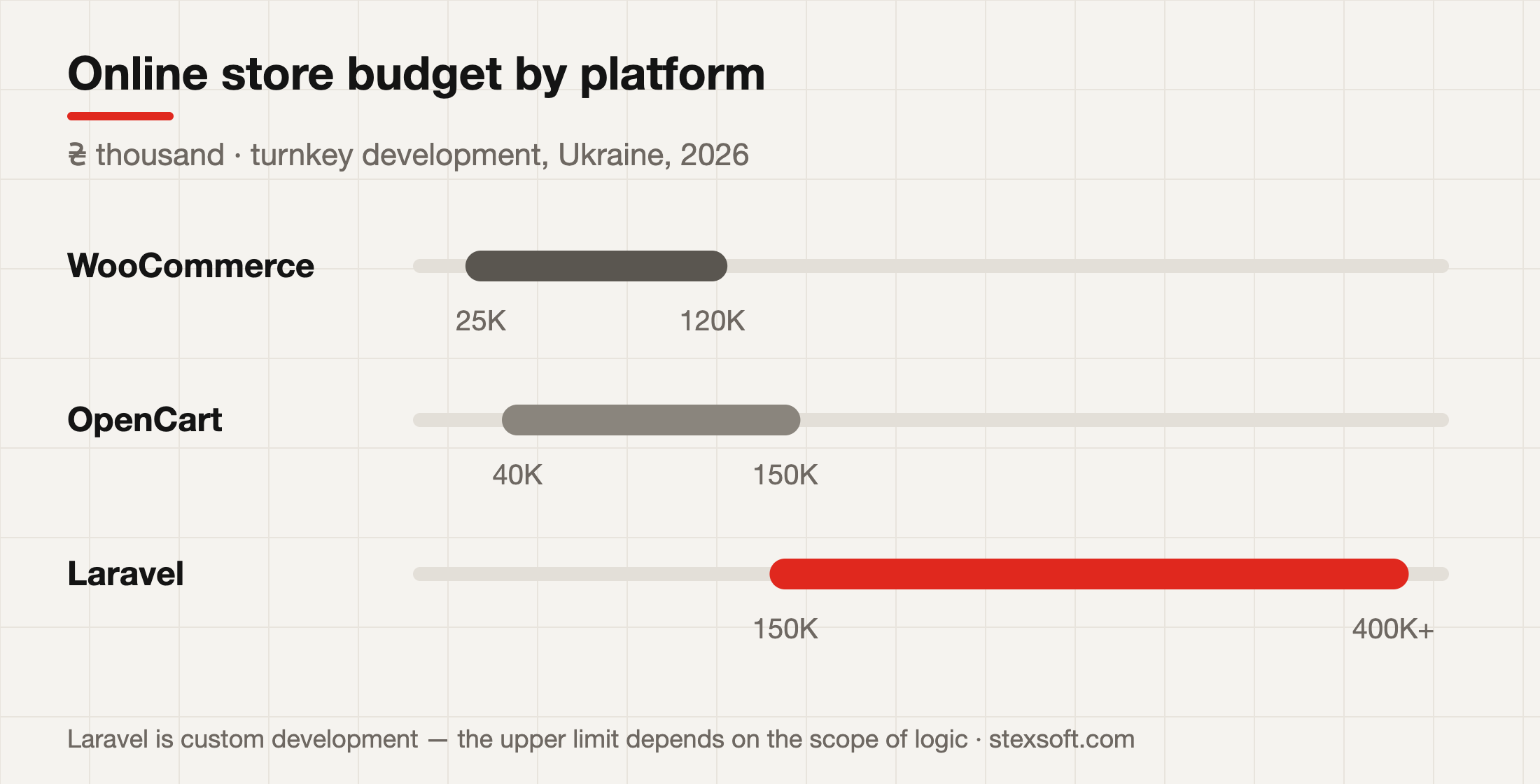
Approximate turnkey budgets at a Ukrainian studio in 2026 (a detailed breakdown of what makes up the price — in our article on website costs):
- WooCommerce: UAH 25,000–120,000. The lower end is a ready-made theme with configuration, the upper — a unique design + integrations.
- OpenCart: UAH 40,000–150,000. A pricier start, but more cost-effective on large catalogues.
- Laravel: UAH 150,000–400,000+. There's effectively no upper limit — it's defined by the scope of the logic.
On top of any platform's budget, add payment integrations — see our separate comparison of monobank, LiqPay and WayForPay.
Cheat sheet: which platform to choose
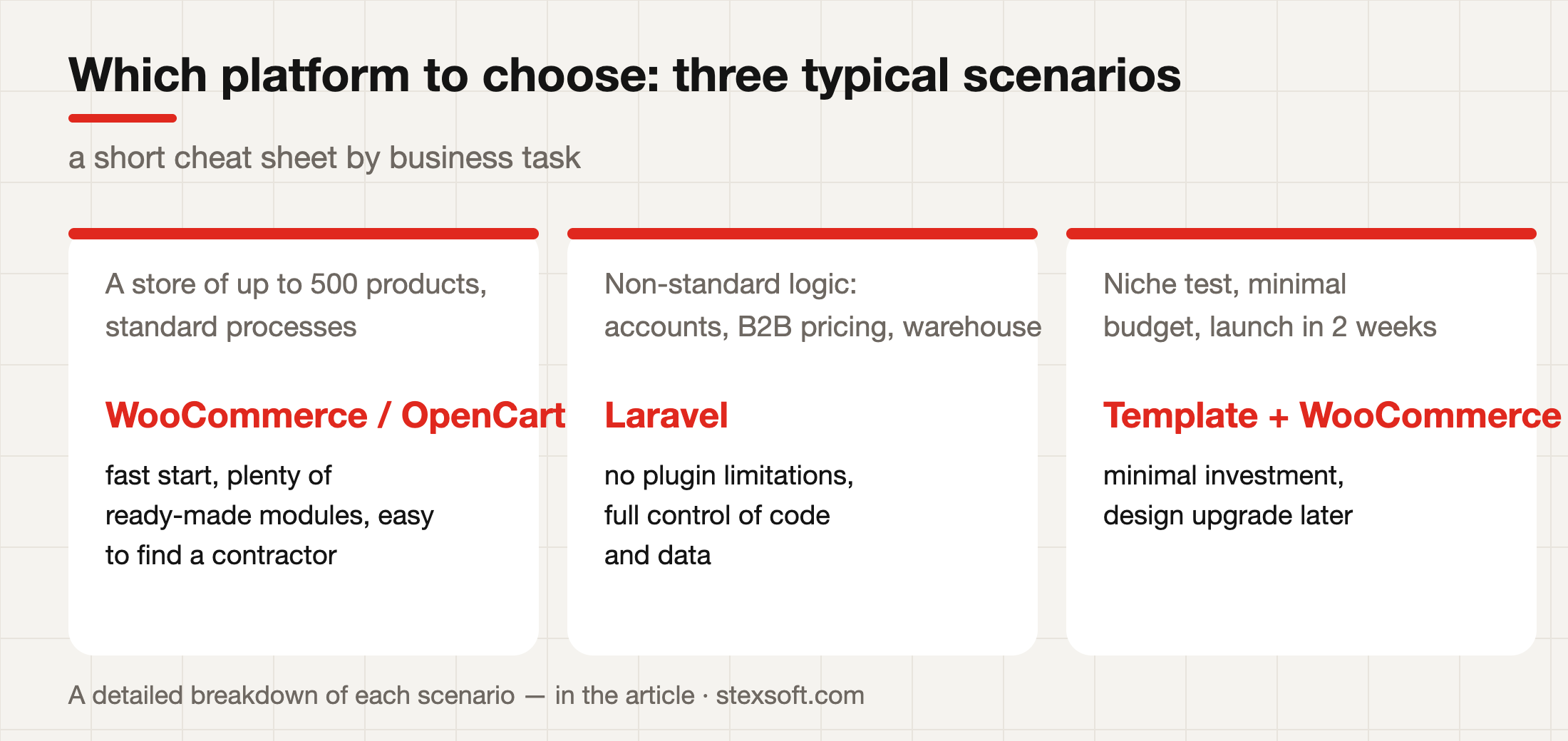
- A standard store + content marketing → WooCommerce.
- A large catalogue, frequent price updates, minimal «blogging» → OpenCart.
- Non-standard business processes, B2B, ERP integrations → Laravel.
- Testing a niche on a minimal budget → a ready-made WooCommerce theme; upgrade later.
And an anti-tip: don't choose a platform because «a developer friend knows it». The platform should fit the business for 3–5 years, not one person's current skills.
Frequently asked questions (FAQ)
StexSoft builds online stores on WooCommerce, OpenCart and Laravel — with payment integrations, delivery, and accounting system synchronisation. Not sure which platform fits you? Describe your task — we'll give you honest advice, even if the answer is «a template is enough for you».
Which platform is the cheapest for an online store?
WooCommerce: from UAH 25,000 at a studio or from UAH 15,000 on a ready-made template. But compare the 3-year cost of ownership, not just the launch price.
Can we migrate from WooCommerce/OpenCart to Laravel later?
Yes, it's standard practice: a business outgrows a boxed CMS and moves to a custom build. Products, clients, and orders are migrated. Budget the migration at 30–50% of the cost of a new store.
Which is better for SEO — WordPress or OpenCart?
At the basic level both platforms are fit for promotion. WordPress is stronger in content marketing (blog, articles), while OpenCart needs refinements for flexible meta-data handling. For visibility in AI search, content structure matters more than the CMS — see our GEO guide.
How much does store support cost on each platform?
Roughly 15–25% of the development cost per year. For WooCommerce/OpenCart it's mostly updates and security; for Laravel it's developer time, so the rate is higher — but refinements are faster too.
What do large Ukrainian stores run on?
The big players are almost always custom builds (frameworks like Laravel or in-house platforms). Small and medium businesses — mostly WooCommerce and OpenCart.
Comments(0)
No comments yet — be the first.
Comments are moderated before they appear.
No comments yet — be the first.